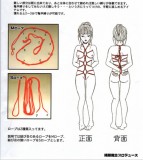
 Here’s another tutorial on karada. The instructions for the previous one are in Chinese (still not translated, by the way, if you speak Chinese, please help), for this one in Japanese (please? ;-).
What is different? Let’s go step by step.
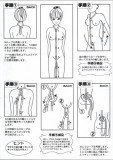
- Two shorter ropes are used. Normally, you would use one ~20-25m rope what makes binding quite difficult. Two shorter rope should solve the problem.
- The knots are “permanent” not “sliding”
- The knots are made on both sides (front and back). Takes more time to measure and properly make the knots, but once done it makes selfbondage easier, faster and safer (also true for the previous item)
- 1a – that loop lowers the top horizontal row of the ropes, what eliminates nasty pressure on the armpits
- 2 – the position of the 4th knot, while perfect for women as pictured, should be adjusted for men. Both sexes can add another knot (between the 4th and the 5th) in front of the anus.
- 3 – the rope is tied off at point “A”
- the rest of the first rope is used to bind arms/wrists
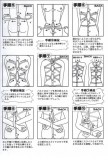
- 4 – the second rope is tied between the 5th and the 6th knots and used for the horizontal rows
- 5-6 – instead of going from top to bottom, the rope goes from bottom to top. The premade knots leave no space to think and simplify the weaving
- 7 – the second rope goes into the loop and tied off
- 8-9 – apparently knot “Z” is a sliding knot (what is quite dangerous)
- 10 – lastly, you can slide X to raise the arms behind the back, make adjustments, and it’s complete.
Definitely something to play with! 😉
How do you get these ‘permanent’ knots in? What kind of knot is it? overhand? double-8?
Saves me from spending another hour on figuring the knots out 😉
an overhand knot would do. Difficult to untie though.
A figure-8 one is easier to maintain, but its too bulky.
Also you can use a square reef knot, which usually used to bind too ropes together. If you have a look at this picture the middle knot and the one at the bottom together would form square knot. Just one knot on that picture I called “a sliding” one. Never use it near your neck.
To the X knot. This knot is used to pull wrists up – after you pull the Z knot down, your wrists will be too low. It’s sliding but only in one direction – well it can be sliding in both directions; the goal is you can’t slide it by pulling your wrists down.
I already use Karadas like these a lot. When combined with Hog Tie #3 they are TRULY AWESOME, but I had never thought of tying the Karada from the bottom up. What a great idea – much easier to get a good result.
To be honest, I can’t say it’s easier. I’ve tried this method. You can’t pull it as tight as you want. The harness literally falls apart. Probably, it’s not for self-bondage, because another pair of hands would definitely helped here.
It does use less ropes, though.
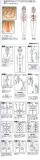
The final picture’s instructions say: lastly, you can slide X to raise the arms behind the back, make adjustments, and it’s complete.
Thanks anony! I’ve updated the article.
This seems pretty cool, but it also looks a little tough without a translation. Can anybody help with that?
I found this site selling pre-made ropes for this, with some real pictures which is kinda cool!
http://tinyurl.com/23asx6x
“Johnny ” wrote:
The translation is in the article text.
do you really need a 20 m rope ? I used 4 schoe ties making another karada (can’t remember if I could fully finish it) but my point is, is it me or isn’t 20 m a little bit to much ?
“random guy ” wrote:
10-12m is an absolute minimum.
“random guy ” wrote:
And you’re asking why it hurts? ;-D
“random guy ” wrote:
To some it’s ‘The more rope, the better.’ =) *Raises hand*
But yea, shoe laces are pretty bad. WAY too thin! For a good karada (or any SB session really) you need rope of at least 7mm diameter. Also use soft rope. Tie-ing it is a bit tricky, but possible.
Conventional sources:
– Hardware store
– Boat store.
Hrdware store is where I got about 90% of my ‘stuff’. GF and I bought about 7% from ‘other stores’ and the remaining 3% I make myself.. 😉 (Ordered a small set of ‘pager motors’. Those tiny things have a pretty big kick.)
“Tinkering_Daemon ” wrote:
sorry as far as I know the hardware store only has industrial type of ropes, the really strong ones
and a boat shop ? not really something you can find around here x’D
I just wished it wasn’t this hard to actually do “something” its like: you can do 1001 things actually but need 2002 things to do this, you understand ?
Do not overcomplicate the simple things. The hardware stores sell various types of rope. I usually buy the most soft available – you can double it up with no “minimum radius”.
I second Tinkering_Daemon about the thickness. At least 7mm. 10mm is better.
About the length. You can easily calculate the bare minimum. Just measure the length of your torso (crotch to shoulder). In my case it’s a bit less than 90cm. Both ways = 180cm. Since you double the rope up = 360. You see? No knots, no horizontal layers and already almost 4m. Then waist (78cm) and chest (92cm). At least three double loops. 3x85x2=5m10cm. In total 9m10cm. So, the bare minimum is 12m. It’s possible to use a 10m rope, but you will struggle to make the final knots. Or it will not be complete.
What you do NOT want for any sort of bondage is the hard blue nylon ‘industrial rope’. Boating shops sell any number of different types of rope for diverse ‘legitimate’ purposes, some of them at fiercely expensive prices. I like chains and shackles myself, you can see where your money’s going…
Those who live in NL, DE, BE, AT, LU know these outlets. I usually buy rope, chains and steel “details” (don’t know the appropriate name for rings, snap-locks, etc) in such shops as Hornbach, Praxis, Obi, etc.
Maybe others have thought of this before. If so, Sorry to rehash this again.
In picture 9, I would a wrist coil, and the slip-knot “Z” would tighten the wrist coil.
In picture 10, I would add a snap-hook or ring at “X”. This would then be connected to the SRD at your ankle tie.
When you pull the SRD tight, the ring pulls the wrists up and when both knots touch each other, you will be stuck.
Even if you manage to loosen or brake the SRD, your wrists will still be tied, because then both knots “X” and “Z” are pulled together, They will both tighten to the point that both will not give any slack at all.
The only way out is with a knife
I have done this before and it works very very well.
I had found this technique interesting! i had never tried a Karkada with hands tied behind me before, I can can do a self “Tekate Kote”, Gyaku ebi” and self tsuri.
Are there any other self bondage techniques similar to this one? ( Not including basic self bondage) Is there either a translation? I have learned only a couple of Japanese terms for Kinbaku or is there a picture with English subtitles?
did anyone get an english translation on this yet?
Or at lease their version of instructions?
“Tinker D ” wrote:
The translation is in the post.
101,674 views!
Far out.
“Martin ” wrote:
I don’t really get how the X knot is tied, I have to view this on an IPad though.