Hi all, I'm new to the forum and located near to London. I have an interest in aprons especially pvc / plastic ones and would love to talk and share thoughts with other likeminded people.
I'd been mulling over the vertical spread eagle idea from http://www.likera.com/blog/wp/archives/1246 and how to improve the release mechanism and problems with getting into the position I'd had at previous attempts. Anyway, suffice to say I think I've come up with a neat solution which works well.
1. The frame
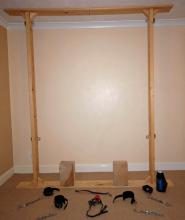
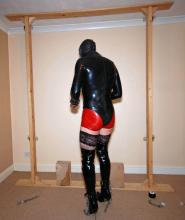
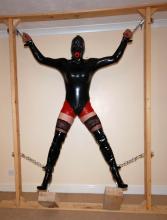
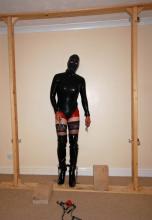
First I built a strong wooden frame (see pic 1) which was designed to fit tightly between ceiling and floor. I've used this before when first experimenting with this idea and it works fine. Basically two planks about 200x15mm and 3-4m long, one for the base (floor) and one for the upper cross piece (ceiling). Two uprights of about 100x50mm and just long enough to be hammered into place as a tight fit between the base on the floor and the upper cross piece on the ceiling. These are then kept in place using eight triangular corner wedges screwed into place.
Pic 1
1. The release mechanism
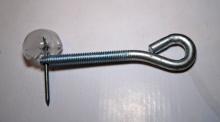
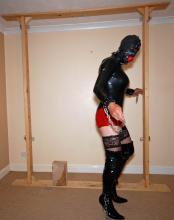
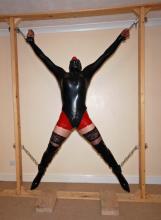
I wanted something simple and pretty foolproof as getting stuck isn't an option. Ice locks work well but not when subject to your whole body weight as it tends to shatter too easily unless you're hanging off a whole iceberg! So the ice lock has to hold something else that takes the strain and then releases when the ice melts. I decided that four M10 eyebolts would be the anchor points. I drilled a hole though the bolt end so that a metal pin (in this case a nail with the head sawed off) of smaller diameter than the drilled hole could hold the eye bolt in place in the wooden frame creating a solid anchor. The top of the pin can then be frozen in an ice cube such that it won't be able to drop through the hole in the bolt end of the eye bolt until the ice melts. Voila! (see pic 2).
Pic 2
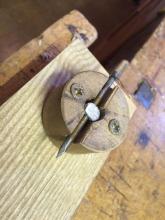
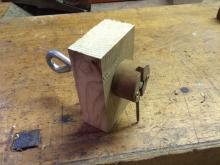
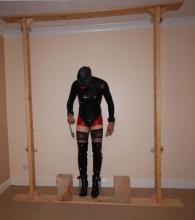
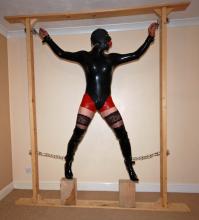
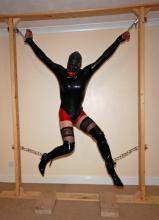
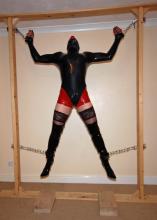
Ok, a few modifications are necessary. First you need a stand-off between the outside of the frame and the pin/ice cube arrangement so that you don't bend the pin or shatter the ice under your body weight. Second you need to delay the melting out of the pin a little. Metal conducts heat very well and so tends to melt out of the ice cube very quickly. You can remedy this by filing a slot around the head of the pin and tying a few cotton threads on to it. When frozen in the ice cube these don't conduct heat and although the pin might melt out quickly, the threads take longer adding extra time to the ice lock. The longer the thread, the longer the wait until release time. Experiment and do some dry (wet?) runs first and be aware that it depends on the temperature of the room also. I also noticed a tendency for the stand-off to rotate under load and top-heavy weight of the ice cube and so allow the pin to slip out when it rotates fully 180 degrees. I rectified this by cutting recessed slot in the stand-off for the pin to sit in and screwing the stand-off onto the outside of the frame (see example set up in pics 3 and 4 - minus ice cube). You can see in pic 4 that when vertical and with the ice lock melted the pin slips straight through; even under load a little wiggle of the anchor allows the pin to fall freely through and thereby release the eye bolt.
Pic 3
Pic 4
(hint: freeze your pins in the ice cubes supported by a simple piece of hardboard with a grid of holes drilled in it the same spacing as the recesses in your ice cube tray. I then take them carefully out... sitting the ice cube tray in some warm water helps... and always do more than you need as some can shatter as they are removed. I then placed them in a pre-cooled wide-mouthed drinks vacuum flask to keep frozen until needed).
3. Getting into position
The girl in the cartoon makes it look easy. It isn't! The blocks tend to wobble alarmingly and it is easy to fall and do yourself some damage as you balance precariously on these trying to attach ankle and then wrist chains to the eye bolt anchors. To reduce the wobble-factor I screwed a metal door hinge to the base of the blocks and then to the base of the frame. This provides a remarkable amount of extra stability while you mess with chains and anchors. A swift kick forwards is all that is needed to topple the blocks and you're hanging in a vertical suspended spread eagle position.
4. Ready?
I used double-ended triggers to attach the ankle chains to the lower eye bolt anchors and then padlocks to attach the wrist chains. This means you have to wait until the ice melts and the pins fall out. I did a dry run with triggers on the wrist chains as well to get chain lengths right and test the ice locks. I suggest you do too to make sure everything is the right length, height, load-bearing capacity, that the pins fall freely, that the ice melts... and you don't get stuck. It is a good idea to have a back up. Tie the padlock key to the end of a long piece of string and the other end to your wrist (it'll take you about as long to wind the string round and round your finger - bringing the key to your hand - as it does for the ice to melt).
5. Really ready?
OK here goes... Oops! Nearly forgot to dress accordingly! I decided on the black Libidex latex body with full sleeves, red latex shorts, lace-top hold ups, thigh length PVC boots with 4" heel, latex hood, a lockable slave collar, a mouth-filling "Kong" harness gag (see http://www.likera.com/forum/mybb/showthr...p?tid=1210) and my falsies! All in position? Right... kick! I do love the frisson of excitement as you get ready to kick the blocks away and the snap of the chains as they come taught. This session lasted ten minutes before the ice locks melted enough to let the pins drop... which was enough (I can feel my back and arm muscles aching as I type this some 5 hours later). Here are some pics for you...
I've always been fascinated about different ways to enter a skin tight suit.
Once I tried to enter my latex leotard from the crotch. I closed the zippers and opened only from the crotch so that I could first but my legs in and then began to slowly work my upper body in from the same hole. It was very difficult because I had no lubricant but I managed eventually to get my whole body in.
I even tried once to enter a PVC leotard from the other leg hole but that wasn't a success.
Now I'm thinking about buying a latex neck entry catsuit with a crotch zipper. The only difference I'm gonna include to my order, is to select the thickness of the latex to be more than 0.6 mm, so it should not be possible to enter or escape the suit from the neck.
Well I guess you've already figured out what I'm planning to achieve. It's just something that needs a lot of flexibility. I still don't know if I'll even be success in this plan of mine.
I tried to google about this but didn't manage to find anyone else who'd have tried something familiar. What do you think about this crazy idea of entering a catsuit? And if you'll have any other ideas, I'd be happy to read about those too. 😊
Can anybody recognize these shoes? Any ideas where to buy them? I asked Sabrina Violet (she's on the photo), but I'm not holding my breath for her answer 😉
o- better no platform
o- the heels can be a bit lower (around 4" ?)
o- mat leather, patent leather - does not matter
o- open toes (can be more open, than on the photo)
o- this is the ankle strap I need.
I could not find a general thread about rainwear, so, here it comes.
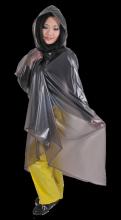
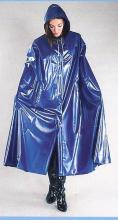
I like rainwear for as long as I can remember. When I was young (60s, early 70s), raincoats used to be yellow and were made of oiled fabric, somewhat close to rubberised cloth. Today, some fabrics come pretty close again, coated with PU, PVC or Polyesther. Others are completely different. Cheap rainwear made from PVC is awful, expensive PVC rainwear can be awesome.
Well, I am not trying to convince anyone of the fascination of rainwear, but this thread needed an introduction. Let's collect rainwear here, images, videos, shops, experiences, findings on (in?) the attic etc. I have searched the internet for quite a while. Of course, I never exactly found, what I want. Maybe this thread will help me, and others, to whom it didn't even occur to ask here 😉
Hey. I just got my chastity CB6000s or i think that was the name atleast and it works supergood. the only thing is that i do not have a keyholder for it. This is due me living most parts of my life in a little town with just 400ppl or so and things like this isnt exactly normal to be interested in. well enough about that, what i wanted to ask for is Ideas on i can fix so that i may have 2weeks locked or more or less or something like that without being able to reach the keys for the lock within the time.
Or maybe someone here wants to keep my keys secure 😋
Hi all, i'm an old reader of the forum and this is my first post.. I'm sorry for my english and mistakes. I don't remember any post about this thing so excuse me if i repost this.. Today i saw this video (
and my kinky mind immediately brought me back of the possibilities in Self-Bondage.. Is there anyone who "play" with this? Any feedback or just some ideas on what to create for selfbondage?.. I was thinking of some dildo/gag or some type of padlock.. Let me know!
Open Thread
A while ago, Sub-Shop annouced closing and actually did. I happened to see an image of one of their models tonight and it linked back directly to the shop, which apparently is in business again. I have never ordered from them directly, because I found similar stuff in Germany, but they have always been a good source of inspiration:
I owe them the discovery of the "bolero armbinder".
It seems, that they have a nice choice of armbinders in various styles. Perhaps worth taking the hassle to order from US, despite high shipping cost, custom fees etc.